Showing posts with label History. Show all posts

Tuesday, 30 April 2013

Myths and Legends - Book Reviews


Myths and Legends is a new series of books from Osprey, publisher of military history books combining historical information with beautiful illustrations and images. The series will examine “the great stories that have echoed down through time and have helped to shape our cultures” (from the Osprey website).


Jason and the Argonauts


The voyage of Jason and the Argonauts and their hunt for the Golden Fleece is one of the most enduringly popular of all of the Ancient Greek heroic myths. Accepting the quest in order to regain his kingdom, Jason assembled a legendary crew including many of Greece's greatest heroes such as Hercules, Orpheus, Atalanta, Telamon, and the twins Castor and Pollux. With this band of heroes and demi-gods, Jason set sail in the Argo on a journey across the known world. During their quest, the Argonauts faced numerous challenges including the harpies, the clashing rocks, the Sirens, Talos the bronze man, the sleepless dragon that guarded the fleece, and of course the fickle will of the gods of Olympus.

Dr. Neil Smith retells this classic myth, examining its origins, its history, and its continued popularity. The text is supported by numerous illustrations both classical and modern, including numerous artwork plates especially commissioned for this work. (Synopsis from Goodreads)
 ---

First off, this is a beautiful book. Fantastic illustrations, a good use of images of ancient artefacts and statues, colourful and pleasing to flick through; this is the kind of book that you want to pick up the instant you see it.

Jason and the Argonauts tells the myth of the ancient Greek hero Jason and his voyage to claim the Golden Fleece. It begins early in the myth and tells each stage in detail, providing background facts and information. Despite studying Classics at university, I’m actually not that familiar with the Jason myth – it’s about the only one that I didn’t touch on – and there were a lot of new things to learn in this book. The story is told in an engaging style and it’s a very easy read. The illustrations also add a lot to the story, helping the reader to imagine various events. The book is obviously meant as an introduction to the myth, and it does this well.

I did enjoy reading about Jason’s journey, but I couldn’t help wishing there had been a little more extra information alongside it. I loved the little asides that talked about ancient Greek ships and weapons, or plotted a map of the Argo’s route, or that added background to various characters, and I would have really liked more of these. For instance, a diagram of a Greek ship might have complemented this particular myth very well. I would also have loved a little more information about Atalanta, the one woman hero on the voyage. She is briefly mentioned, and it’s obviously rare to find a female ancient Greek hero, so it might have been fun to find out how she came to join Jason’s quest.

This is a fun book, well put together and visually very appealing. I think anyone interested in mythology, or in learning about ancient Greek heroes would enjoy it, and could find a place for the collection on their shelves.


Dragonslayers


From legend and mythology to The Hobbit and A Game of Thrones, the dragon is a perennial favorite in the fantasy genre.

With its fiery breath, scaly armour, and baleful, malevolent stare, the dragon became the ultimate symbol of evil and corruption in European folklore and mythology. Often serving as a stand-in for Satan, or the power of evil gods, dragons spread death and hopelessness throughout the land. Only heroes of uncommon valour, courageousness, and purity could hope to battle these monsters and emerge victorious. Those that did became legends. They became dragonslayers. The list of dragonslayers is small, but it is filled with great and legendary names. Hercules, Beowulf, Cuchulain, Sigfried, Lancelot, and Saint George all battled to the death with dragons. Other heroes such as the Danish King Frotho, the French Saint Mercurialis, the Polish champion Krak, and the Russian warrior Dobrynya Nikitch might be less well known to western readers, but also fought and defeated dragons. This book will retell the greatest legends of this select group of warriors, while examining the myth of the dragonslayer in a historical, mythological, and even theological context. (Synopsis from Goodreads)
 ---

I enjoyed this book more than Jason and the Argonauts. It looks at the myths and legends of dragon-slayers throughout history, telling their stories and looking at various information surrounding each myth, such as historical records and recurring themes. I liked how the author didn’t limit himself to a rigid modern (and European) definition of what a dragon is, but looked at how ideas of dragons have changed through time and in different societies. This allowed him to include snake-monsters, sea-serpents, wurms and other nasties, and it was fascinating to see how dragons and dragon-slaying legends began and how they developed.

I really loved the amount of additional information that the author provided in this book. I found details about sources and historical records fascinating, and I enjoyed little asides about how the various legends had been used in film and literature, as well as potential real-world influences on the legends that involved real historical figures (crocodiles seem to have been a common culprit). There was so much in this book that I didn’t know (for example, spiked armour pops up a lot in the British dragon-slaying legends). I also didn’t expect there to be so many dragon-slayer stories that I’d never heard of before. The book was very well researched and a joy to read.

This was a really fun and informative book, with some wonderful illustrations and images that really brought the stories to life. Both these beautiful and interesting books represent a very strong start to the Myths and Legends series. I’ve already got my eye on the next titles!


Saturday, 17 November 2012

The Case of the Deadly Desperados - Book Review


Introducing P. K. Pinkerton, Master of Disguise. When twelve-year-old P. K. (Pinky) Pinkerton's foster parents are murdered by Whittlin' Walt and his gang of ruthless desperados, Pinky goes on the run. He's forced into hiding with Ma's priceless last possession: the deed to a large amount of land and silver mines in the Nevada Mountains. But relying on disguises will only keep Pinky hidden for so long, and the desperados are quickly closing in... (Synopsis taken from Goodreads)

The Case of the Deadly Desperados is the first in a new series of mystery books from The Roman Mysteries author Caroline Lawrence. It follows P. K. (Pinky) Pinkerton, a twelve year old private eye in the year 1862. This series seems to be ‘The Western Mysteries’ if you’re in the USA, or ‘The P.K. Pinkerton Mysteries’ if you’re in the UK, because apparently our children don’t really know what a western is anymore. Hopefully this series might change that, if the strength of the first book is anything to go by. It’s an exciting, action-packed adventure in which Pinky never seems to be out of danger. All the traditional elements of a western are there, as well as plenty of interesting facts about the real Wild West.

Saturday, 2 June 2012

The Piano Tuner - Book Review


The Piano Tuner, by Daniel Mason, is the story of Edgar Drake, a piano tuner sent to Burma to fix the Erard Grand Piano of Surgeon-Major Carroll. Edgar travels from London to India, where he catches a train, then a boat to Burma, finally travelling through Burma to Mandalay and on to Mae Lwin in the Shan States where the Surgeon-Major is stationed. Here he works on the piano while enjoying the peace, beauty and seductive charms of the idyllic Burmese village. As he grows more nervous concerning Surgeon-Major Carroll’s unorthodox methods for establishing peace, he nevertheless falls completely in love with the land and its people. However, the British Army does not share Edgar and Carroll’s desire for harmony and understanding, nor their belief in the power of music.

The front cover of this book promises three things: extraordinary, seductive, haunting. If these words adorn the front of the book, then the reader is going to expect just this. Now, it did not quite meet ‘extraordinary,’ but two out of three isn’t bad, right? Unfortunately, this book made me realise that ‘seductive’ and ‘haunting’ are all very well, but they do not necessarily equate to a great story.

The Journey: Potential for ‘Extraordinary’?

 
The book begins promisingly. Edgar is an intriguing character, a little dreamy and introverted, a little odd, but deeply passionate about music in a way that convinces the reader to be deeply passionate about music with him. It is very easy to like him, to feel for him, to sympathise with him. Right from the get-go he is uneasy about the typical Victorian imperialistic attitude to the East, and dislikes society’s racist opinions of the ‘Oriental’. He does not like the army on principal, and sympathises instantly with Carroll because of his efforts to promote peace. Edgar is a guy we can get behind. This does leave the question of exactly how Edgar will grow and change on his trip, however. Does he actually have anything to learn? Might it have been more interesting to see the more ‘typical’ middle-class Victorian suddenly thrown into Burmese life?

Edgar’s journey is also promising. He encounters a man on the boat, known as ‘The Man with One Story’ who launches into a haunting tale of mysticism, magic, and the devastating power of music. This is meant to complement Edgar’s own journey, both physical and emotional, but it is slightly unfortunate that this ‘mini-story’ is far more intriguing than anything that happens to Edgar. Still, Edgar’s journey continues. On the train across India he sees a boy at a station who wants to sell him a poem, a tale of the leip-bya of Burma. The train pulls away before Edgar can hear it, but the story of the leip-bya will be visited again later in the book. Edgar faces other events on his way to Mae Lwin including a tiger hunt which goes badly wrong, in which he must face his own attitude and realise that despite his best intentions he is still just another British intruder. Edgar sees beauty, strangeness, mysticism, violence and oppression. He sympathises further with the Burmese people. Over the journey the reader has been taken from the gritty realistic feel of London into a world of magic and ‘otherness.’ Edgar has seen things that bewilder and intrigue him, and is adjusting some of his own attitudes to become a better person.

Problems and Dreams


Unfortunately, the book does not stay on a high note for long. In between the beautifully written moments of awe, or the suggestions of the supernatural, Edgar’s journey is a somewhat boring list of places reached and then instantly left, like the author is ticking off points on a map. This is interspersed with a fairly dry history of the Shan people, followed by an even drier history of Erard Grand Pianos. Despite Edgar re-assessing some of his preconceptions (such as the patronising belief that they can ‘bring music’ to a country that clearly has its own rich musical traditions), he does not really change at all. In fact, he barely reacts to anything around him. He seems to be drifting along as if in a dream, letting things happen to him without engaging. He is possibly the most passive main character I have ever read about.

This is, perhaps, intentional. Edgar’s entire time in Burma feels like a dream to him, and he writes home to his wife that he is losing a sense of what is real and what is only imagined. This connects to the story of the leip-bya, the Burmese word for a person’s spirit or soul, that flies around moth-like at night and returns at daybreak. The leip-bya’s nightly excursions are responsible for dreams. Edgar’s own connection to the leip-bya seems to suggest that he is also flying around moth-like, experiencing a constant dream from which he needs, or perhaps can never again, wake up. This is enhanced by references to the Lotus Eaters from the Odyssey, as well as the story of Gautama. Edgar is the man who has fallen in love with a dream-land, who has left his wife and everything else behind to live in an idyllic new land. The reader is never quite sure if this is a wonderful thing, or a deeply sinister thing.

Haunting and Seductive, but at the Expense of Story and Character?


This is the strength of the book, but also its failing. Daniel Mason gives the reader ‘haunting’ and ‘seductive’ in bucketloads. The story is strange, ethereal and surreal. It never quite feels real, and the constant references to dreams, illusions and magic, as well as to men lost to other lands, adds a clever and enjoyable element to this. However, this also means that Edgar never really steps up and becomes an interesting character. He never does anything, simply observing and letting things happen to him. His feelings and emotions are therefore unconvincing, and his extreme love for Burma slightly baffling. He remains so much on one emotion throughout the whole story that it is hard to pinpoint exactly what makes him so desperate to stay here.

The story itself, as well as the setting, also falls a little flat. In an effort to keep everything feeling so dreamy, the author appears to have neglected to keep his plotting tight and his descriptions evocative. There are plenty of long, rambling sentences about what Edgar sees around him, and yet none of these creates a sense of anything beyond Edgar’s impression of beauty and slight bewilderment. In other words, we are told that what Edgar experiences is beautiful and wonderful, but we do not see this for ourselves. I expected lush descriptions that would make me feel as though I was transported to Burma. I wanted impressions of what this place feels like, smells like, and sounds like; I wanted similes and comparisons that could make me feel as emotionally connected to it as we are informed that Edgar is. I did not get this. In fact, I cannot picture what Mae Lwin, or indeed Burma, looks like at all. The book left me with a hazy dream-image, an impression of heat and trees and a river, but nothing more. This certainly complements the theme and ideas of the story, but it is disappointing nonetheless.

Daniel Mason also has a style of writing that began to grate on my nerves a little. He switches between past and present tense without warning, and seemingly at random. Sometimes this generates a sense of confusion that connects to Edgar’s feelings, but more often it feels as though the author simply forgot what tense he was writing in. At other times, quotation marks indicating speech would disappear without warning, only to reappear again a few paragraphs later. These ‘quirks’ were, presumably, meant to add to the sense of dreaminess and disconnect from reality, but I just found them distracting and annoying. To a certain extent this is what I get for reading a book from the literary fiction genre (yes, literary fiction is a genre. It can pretend all it wants but it’s not fooling anyone), but in general I have nothing against this kind of experimentation, if it feels appropriate. Once again, too much time spent enhancing the haunting, dreamy air, not enough spent on good, simple storytelling.

Ending: The High Point


Despite its problems, The Piano Tuner is perhaps worth reading for the end alone. Suddenly all the meandering elements of the story are drawn together and reality kicks in again with a bang. There are revelations that are surprising and shocking, and a twist-that-could-be-or-not-be-a-twist that is left for the reader to ponder. The story is left on an ambiguous and gloriously bittersweet note. It is a tremendous shame that the majority of the book did not share the same powerful writing and emotional impact as the ending. This is an ending that I will definitely not forget, even as the rest of the book fades into dream.

Monday, 28 May 2012

The Sewer Demon - Book Review


Euge! I won a signed copy of The Sewer Demon by Caroline Lawrence in a Twitter competition from the Big Book Babble! This sent me into slightly unreasonable levels of excitement. Partly because I’ve never won anything in a prize draw before, but mainly because The RomanMysteries series has been a favourite of mine for a long time.

But, aren’t they children’s books? Yes, of course they are, but like Disney cartoons, they’re absolutely delightful for grownups too. I would class them as ‘family books.’ They’re funny, clever, exciting, and historically accurate. I think they are some of the best stories set in the Ancient World in either adult or children’s fiction. Besides, I’m fairly sure I never actually grew up...

I was introduced to the Roman Mysteries books by my cousin’s daughter, who a) was in love with the series, and b) was amazed and overjoyed that she had written to the author, Caroline Lawrence, and Caroline had actually written back! Not all authors will do this, mainly because they are so busy, but I remember having a similar experience when I was younger and it really does make such a difference to a child. Anyway, I was studying Classics at university at the time, so “it’s about Romans” was (and still is, if I’m honest) enough on its own to get me excited. A combination of ‘Romans’ and ‘friendly author’ meant they were a must-read. I borrowed one from the library, reading horribly out of order (The Sirens of Surrentum), and on the strength of that one book alone I bought a set of all the books written to that point, with the beautiful second generation covers. Every single one was good, and I’ve been collecting them ever since.

The Sewer Demon is a companion book to The Roman Mysteries series, moving away from the Roman Mystery children to focus on a new main character, a boy called Threptus. Readers of The Roman Mysteries books might remember Threptus, who popped up in The Man from Pomegranate Street, and in ‘Threptus and the Sacred Chickens’ in The Legionary from Londinium and other Mini Mysteries. Threptus is an eight year old boy living in Ostia, once a beggar, but now working for Floridius, who is a prophet, soothsayer, amulet-seller and dealer in sacred chickens! This is the first in a new series called The Roman Mystery Scrolls, which seems to be aimed at slightly younger readers, with shorter books and ruder humour.

The same easy-going and humorous style of The Roman Mysteries series is found in this book, with plenty of jokes that both young readers and their parents can enjoy. The curses (Pollux!) and exclamations like ‘Great Juno’s Beard’ always make me laugh out loud. Because the story is set in Ostia, familiar faces and places appear. At one point Threptus is forced to crawl through the town’s sewers, and learns why the local magistrate Bato should never eat cumin-dusted eggs. The mystery is intriguing and solving it is fun, with the usual variety of fascinating Roman facts and titbits incorporated into the story. I’ve never noticed anything un-historically accurate in a Roman Mysteries book, and the same goes here (makes sense – the author really knows the Ancient World).

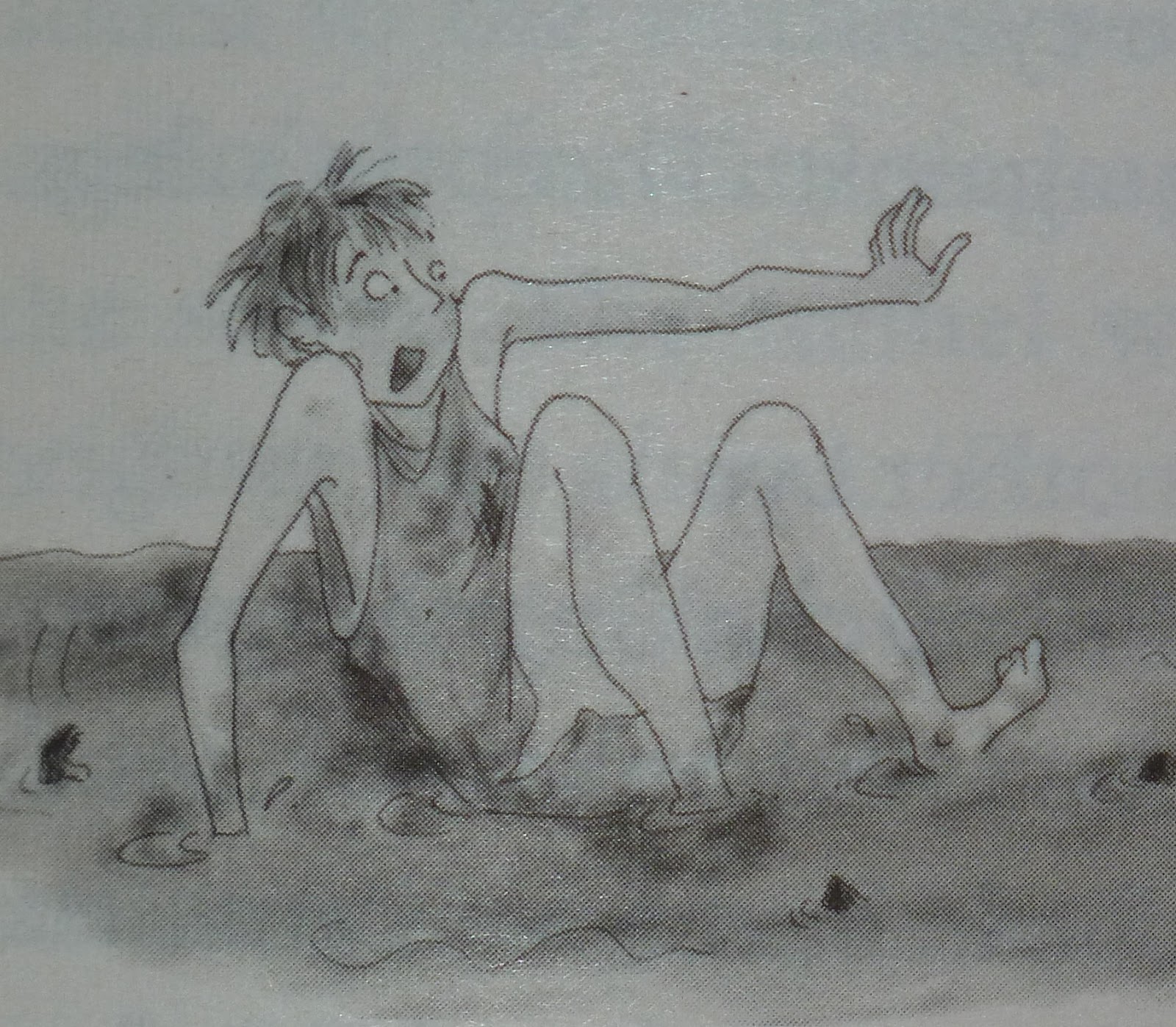
Caroline Lawrence has a wonderful ability to conjure up places and people so well in so few words, and her characters are always so alive they jump off the page. (The little illustrations that accompany each chapter pick up on this brilliantly. Here’s my favourite.) The pacing is spot on, there are no boring bits, and no scene is wasted or ‘filler.’ It’s a very easy read. This would make it a perfect book for younger readers or less confident readers, before diving into the more complex mysteries and plotting of the Roman Mysteries stories. It’s also a great companion book for readers who are already fans of the Roman Mystery world.