Showing posts with label Children's. Show all posts

Tuesday, 9 July 2013

The Rithmatist - Book Review


The Rithmatist
by Brandon Sanderson

More than anything, Joel wants to be a Rithmatist. Chosen by the Master in a mysterious inception ceremony, Rithmatists have the power to infuse life into two-dimensional figures known as Chalklings. Rithmatists are humanity’s only defense against the Wild Chalklings — merciless creatures that leave mangled corpses in their wake. Having nearly overrun the territory of Nebrask, the Wild Chalklings now threaten all of the American Isles.

As the son of a lowly chalkmaker at Armedius Academy, Joel can only watch as Rithmatist students study the magical art that he would do anything to practice. Then students start disappearing — kidnapped from their rooms at night, leaving trails of blood. Assigned to help the professor who is investigating the crimes, Joel and his friend Melody find themselves on the trail of an unexpected discovery — one that will change Rithmatics — and their world — forever.

Bestselling author Brandon Sanderson brings his unique brand of epic storytelling to the teen audience with an engrossing tale of danger and suspense—the first of a series. With his trademark skills in world-building, Sanderson has created a magic system that is so inventive and detailed that that readers who appreciate games of strategy and tactics just may want to bring Rithmatics to life in our world. (Synopsis from Goodreads)

---

I really enjoyed The Rithmatist, though I have to admit I wasn’t at all sure about it at first. The chalk magic was... weird, and to be honest, didn’t seem that useful. So rithmatists can battle other rithmatists in impressive chalk-magic duels, but in real life, isn’t any normal person with a gun or a bucket of water at a fairly big advantage? Scribbling protective circles and chalk monsters takes time, after all, and chalk’s quite easy to scrape or wash away.

Well, actually, I was wrong to doubt, as all these things are explained and become much clearer later. As the book progressed, it became obvious that chalk magic is actually a lot more powerful than I’d thought, and that the seemingly arbitrary rules of it do actually make a lot of sense. I’m not sure I still fully understood the chalk magic by the end, but I did have full confidence that the author knew exactly how it worked, and that the world was working on great internal consistency. No getting out of situations by suddenly introducing new abilities, but instead by using the established rules to outwit the enemy. I really enjoy that kind of thing, and appreciated it here.

I do think, however, that it took a little too long to get to this stage. I spent quite a long time frustrated by the chalk magic and even a bit bored by it. The main character is obsessed with it, and so talks about it constantly, and his enthusiasm didn’t really spark my own. This is a shame, as, by the end of the book, I was really getting into the magic and enjoyed the various battles and duels that came up. I liked how there was a maths aspect to the magic – the circles must be as precise as possible, the angles of any lines just right, and so on – but also a more creative element – the more detailed and imaginative the chalklings, the more effective they are. By the end of the story, the magic is fascinating, and I was impressed that the author could make chalk drawings such a creepy concept.

The story itself is very slow. The book spends a long time with Joel and Melody in the school, learning about rithmatics in detail and trying to solve the mystery of the kidnapped rithmatists. Everything had a familiar feel, and at points felt very similar to Harry Potter (not necessarily a criticism; I love Harry Potter!). The mystery element was very good, and I enjoyed Joel and Melody’s growing relationship, but I couldn’t help wishing that the whole thing would move along a little faster. I wanted to know more about Nebrask and the Wild Chalklings, the ceremony, and so many other things, and felt like this book was perhaps too much a 'scene setter' plot, introducing the world so that later books can go on to more interesting places and stories.

But, as I said, I did really enjoyed this book. It has a fascinating world, a kind of alt.history steampunk with a fun setting. It’s not quite our world (the States of America are the Isles of America, for one thing), but similar enough to be almost the same. The connection of the church to the rithmatic magic is intriguing, and I can’t wait to find out more about why that’s the case. The chalklings are surprisingly creepy, and once we get past all the theory, the magic is exciting. I liked all the characters, and particularly the fact that Joel is not a rithmatist or ‘super special’. He and Melody really have to work together to achieve greatness, which was nice. I also liked Melody’s melodramatic character. I love the idea of the Wild Chalklings and the strange figure that Joel encountered. I think they may not turn out to be the unambiguous enemy that the characters think of them as, and I can’t wait to find out more in later books. Finally, the book itself is so nicely presented, from the gorgeous cover to the illustrations and diagrams inside.

So, while The Rithmatist had a slow start, and took a while to convince me about the magic, I did really enjoy it in the end, and I’m looking forward to seeing what happens next. A fun read!


Thank you to Orion Children's Books for providing a review copy of this book in exchange for an honest review.


Monday, 22 April 2013

From Rome to the Wild West - An Interview with Caroline Lawrence


Caroline Lawrence is the author of the fantastic Roman Mysteries series, which follows a group of child detectives all around the ancient world, and of a new series which is called Western Mysteries in the USA and P. K. Pinkerton Mysteries here in the UK. As you can probably guess from the name, these are set in the 19th century American West, and they are just as absorbing and exciting as the Roman Mysteries.

I’ve been a huge fan of Caroline’s writing ever since I picked up my first Roman Mysteries book in the library (recommended by my cousin’s daughter). I was reading completely out of order at first (The Sirens of Surrentum), but soon bought the whole collection and read through in order. They are completely addictive! (You can win a copy of the first or second P. K. Pinkerton Mysteries book in my giveaway here!)
 
Today, Caroline has stopped by to answer some questions about herself and her books.


Hi Caroline! Hope you’re having a lovely day!

I am indeed, Vicky! I just finished the first draft of my fourth P.K. Pinkerton book.

What made you decide to go from Rome to the American Wild West?

For me, writing historical fiction is like time travel. Ancient Rome is one place I’d love to visit in a my magic time-bubble; the other is the American West. I love the landscape, the history and the movies associated with that place. Also, the American West is part of my heritage!

How much research goes into each book?

My whole life is research. Attending Latin classes, going to movies, talking to friends, listening to music, reading books, walking, day-dreaming and travelling: all are grist to my creative mill. But I also do specific research, like browsing the database of Mark Twain’s letters online or attending Roman Re-enactment events.

Have you found out anything really surprising during your research, or busted any Western myths?

Yes, I’m always making discoveries as I do research. For example, most western saloons don’t have those swinging doors, but I love them so much that I kept them. What I didn’t realise was how prevalent tobacco was in the American Civil War period, when I’m writing, and especially spittoons. There were even dainty glass spittoons for women!

Would you ever consider changing any historical facts to fit the plot or to make things more exciting, or is that a big no-no?

I get so much inspiration from real historical events that I hardly ever make changes. One little change I made in my latest P.K. Pinkerton book was putting the exploits of shootist Farner Peel in 1862 rather than 1864.

How many of the places in the books are real, and what made you choose Virginia City as your main setting?

Caroline and StinkE (Caroline's photo)
In 2008 I went on a road trip with my sister Jennifer to find the most exciting setting for my new Western series. The “living ghost town” of Virginia City, Nevada was high on my list because

a) some of our ancestors had lived nearby
b) its heyday was during the Civil War
c) Mark Twain lived there…

But it captured my heart when we drove in and the first person I saw was StinkE with a capital E! (see picture) When I discovered that the owner of the B&B we had booked was a Nevada historian I knew it was meant to be!


Caroline and Jennifer on their road trip (Caroline's photo)

Am I right in thinking that you travel a lot? What’s been your favourite place(s) to visit?

Near Sorrento (Caroline's photo)
I’ve travelled to almost all the places where my books are set. I even try to go at the particular time of year when the book will take place so I can get details of weather, bird migration, seasonal food, etc right. I love Ostia, the ruins of Rome’s port, and I think there is something almost magical or perhaps I should say ‘numinous’ about it. I also adore Sorrento and the Bay of Naples, the deserts of the American West, the Sierra Nevada mountain range and San Francisco. In fact, it’s often the places I love that determine where my books will be set!

You grew up in America. Do you have any personal family connections to the history of the American Old West?

Yes! My great grandmother was born in Battle Mountain Nevada and worked for a time at the Carson City mint. Another one of my ancestors was a Union paymaster in the American Civil War.

The Western Mysteries, like the Roman Mysteries, have such brilliant characters. Are any of them real historical people?

I am always using real people! But I try to make them peripheral rather than main characters, (though sometimes they will take over). In my Roman Mysteries you will meet Pliny the Elder, Pliny the Younger, the Emperor Titus, his paramour Berenice, Josephus the Jewish historian, Suetonius the famous biographer and Valerius Flaccus a patrician epic poet, just to name a few. In my P.K. Pinkerton books we meet Sam Clemens AKA Mark Twain and lots of real gunfighters, politicians and newspaper reporters from California and Nevada Territory! I have to be careful there because some of them have great, great, great grandchildren who are still alive!

The main character, Pinky, seems to have Prosopagnosia (difficulty recognising faces), and perhaps also Asperger Syndrome. This can make some aspects of being a detective tricky, but is also advantageous in some circumstances (such as remaining calm when in danger). Why did you decide to write Pinky in this way?

My starting point for PK was that the books would be told in first person without the reader being certain of whether PK is a girl or a boy. (So yes, add gender confusion to those other things!)

Who is your favourite character from any of your books?

In a strange way, P.K. Pinkerton is the most like me. I took my own quirks and eccentricities and exaggerated them to the max!

Do you have any writing habits or a favourite place to write?

I love to write on my Apple Mac in my riverside flat in London (see picture). I’ve found the first few hours of the day most productive. I only write for an average of two hours a day. The rest is ‘research’!

Caroline's flat (Caroline's photo)
 
What’s your favourite book/author?

The Last of the Wine, by Mary Renault. It changed my life because it introduced me to the Classical world. Some of my other fave books are True Grit, My Family and Other Animals, The Curious Incident of the Dog in the Night Time and the historical novels of Patrick O’Brian.

I don’t have much experience of Westerns beyond your books, True Grit, and Butch Cassidy and the Sundance Kid. Can you recommend any favourite Western movies?

My favourite Western film of all time is The Good, the Bad and the Ugly (1966). The others on my list are always shifting and changing but here are four more I think my fans would enjoy: Lonesome Dove TV series (1989), Eagle’s Wing (1979), The Tin Star (1957) and Little Big Man (1970). Notice not one of them stars John Wayne!

Can you leave us with one fun fact about the Romans or about the American West?

First century Rome and Western America in the 1860s had a surprising number of elements in common: both were horse-powered societies, both were surrounded by perceived “barbarians” and both had achieved roughly the same level of medical knowledge. But if I had to choose one to live in, it would be the American West: at least they had chocolate!

Thank you so much for stopping by, Caroline!

Thank YOU! And Happy One Year Anniversary of your great blog!
 
Me proudly wearing my 'P.K. Pinkerton Private Eye' badge!


Friday, 28 December 2012

I Shall Wear Midnight - Book Review


It starts with whispers. Then someone picks up a stone. Finally, the fires begin. When people turn on witches, the innocents suffer...

Tiffany Aching has spent years studying with senior witches, and now she is on her own. As the witch of the Chalk, she performs the bits of witchcraft that aren't sparkly, aren't fun, don't involve any kind of wand, and that people seldom ever hear about: She does the unglamorous work of caring for the needy. But someone or something is igniting fear, inculcating dark thoughts and angry murmurs against witches. Aided by her tiny blue allies, the Wee Free Men, Tiffany must find the source of this unrest and defeat the evil at its root before it takes her life. Because if Tiffany falls, the whole Chalk falls with her. (Synopsis from Goodreads)

I Shall Wear Midnight is the fourth book in the series of Tiffany Aching novels by Terry Pratchett, set in the Discworld. I’ve enjoyed all the other ones, and this didn’t disappoint either.

Friday, 21 December 2012

Charmed Life - Book Review


“There is one absolute rule,” said Chrestomanci. “No witchcraft of any kind is to be practised by children without supervision. Is that understood?”

No witchcraft? Gwendolen Chant - a gifted witch in the making - has other ideas and is determined to get the better of the great enchanter. Her brother Cat, who has no magical gift, is powerless to stop her. (Synopsis from Goodreads)

Diana Wynne Jones has been one of my favourite authors ever since I was a little girl. There’s something almost indefinable about her books, something so magical that makes reading them a truly special experience.

And yet for some reason I have never read the Chrestomanci series. Don’t ask me why – they’re some of her most famous books. Perhaps they simply never had them at my library as I was growing up, and so I wasn’t aware of them. Still, thankfully I’m now putting this right, beginning with book one: Charmed Life.

Sunday, 16 December 2012

The Hobbit - Film Review


This probably doesn’t need much introduction, as it would be pretty hard not to be aware of The Hobbit by this point. The news that the story has been split into three films has been met with quite a lot of scepticism (the book is shorter than any one of the three Lord of the Rings books, and those only got one movie each). So, was it a good decision? And does the film live up to the magic of the book, a beloved childhood classic?

Well... not quite. And I think I managed to go into the cinema without too high expectations. The Hobbit isn’t bad, it just isn’t as good as it should have been, and I don’t think the 3-film decision was a good idea.

My husband and I were talking about it before going in, wondering just how on earth they were going to get three long movies out of the book. I joked that it would probably take an hour for them to even leave the Shire. Oh dear, be careful what you joke! It wasn’t an hour exactly – more like 50 minutes. As in, if this were a TV series, one whole episode would have been dedicated to setting the scene, meeting the characters, and then setting off on the quest. This would actually have been great if it were a TV show, but it wasn’t, and I do think things need to move a little quicker in movies.

Monday, 26 November 2012

The Harry Potter Studio Tour


On Saturday I went to the Harry Potter Studio Tour near London. This is a big site with two hangars full of Harry Potter stuff – memorabilia, costumes, sets, models, props, animatronics, concept art, architectural models, special effects, and tons of information about the making of the Harry Potter movies. Between the hangars is an outside area where you can stop for a glass of butterbeer and hop on the Knight Bus... or take a picture of yourself driving crashing the Weasleys’ car. So much fun!

Saturday, 17 November 2012

The Case of the Deadly Desperados - Book Review


Introducing P. K. Pinkerton, Master of Disguise. When twelve-year-old P. K. (Pinky) Pinkerton's foster parents are murdered by Whittlin' Walt and his gang of ruthless desperados, Pinky goes on the run. He's forced into hiding with Ma's priceless last possession: the deed to a large amount of land and silver mines in the Nevada Mountains. But relying on disguises will only keep Pinky hidden for so long, and the desperados are quickly closing in... (Synopsis taken from Goodreads)

The Case of the Deadly Desperados is the first in a new series of mystery books from The Roman Mysteries author Caroline Lawrence. It follows P. K. (Pinky) Pinkerton, a twelve year old private eye in the year 1862. This series seems to be ‘The Western Mysteries’ if you’re in the USA, or ‘The P.K. Pinkerton Mysteries’ if you’re in the UK, because apparently our children don’t really know what a western is anymore. Hopefully this series might change that, if the strength of the first book is anything to go by. It’s an exciting, action-packed adventure in which Pinky never seems to be out of danger. All the traditional elements of a western are there, as well as plenty of interesting facts about the real Wild West.

Thursday, 13 September 2012

Ante's Inferno - Book Review


Ante’s Inferno, by Griselda Heppel, tells the story of 12-year-old girls Ante and Florence, as they journey through the Underworld with a boy called Gil who died a hundred years earlier. Following a path that leads to the centre of Hell, they face strange dangers and mythical monsters, while at the same time learning more about each other. For Ante, worse than the dangers of the Underworld are the fears that Florence may actually be dead, and that she, Ante, may have killed her.

Sunday, 22 July 2012

The Fish who had Funny Eyes, and Other Stories...

My dad is moving house soon, so I've been looking through numerous boxes of old things. Old books, letters, UCAS forms, photos, beady-eyed cuddly animals, and so many memories... I'll be walking around in a little cloud of nostalgia for weeks! In between all the rummaging and amongst the old toys, I found one of the first stories I ever wrote:

The Fish who had Funny Eyes


Once a fish gave someone a fright, and she ran away. The girl told her dad and he came down the path to the pond. "Help!" yelled her dad, and they both ran away back up the path.


Her dad told her mum, and they all walked down the path to the pond. "Help!" yelled mum, "let's go!" So they ran back up the path and into Granny's house.

Wednesday, 4 July 2012

Hufflepuff Love - Sorted This Way


Image by Jmh2o (Wikimedia Commons)
I just found something awesome I'd like to share - this Hufflepuff Pride Video on YouTube.

I’m a huge fan of Harry Potter (books and films), but there has always been something about the world of Hogwarts that I find slightly disturbing. And that’s the house rivalry. Splitting students into houses is pretty common in British schools (I’m not sure if this happens in other countries so much?), but this is clearly not a good idea where wizards are concerned. House rivalry is supposed to encourage healthy competition and working in teams, but when ‘competition’ involves the power to blow things up, perhaps the wisdom of this needs reconsidering. Particularly when the school decides to give each house its own common room in what seems like an attempt to actively discourage the different houses from socializing after school hours. Why this pointless factionalising wasn’t trashed after the whole Voldemort thing is beyond me. Why exactly do they want to be encouraging more rivalry and prejudice in the wizarding world? And why oh why at the end of the seventh book is Harry Potter encouraging his own child to engage in it? After everything he’s seen?

Monday, 28 May 2012

The Sewer Demon - Book Review


Euge! I won a signed copy of The Sewer Demon by Caroline Lawrence in a Twitter competition from the Big Book Babble! This sent me into slightly unreasonable levels of excitement. Partly because I’ve never won anything in a prize draw before, but mainly because The RomanMysteries series has been a favourite of mine for a long time.

But, aren’t they children’s books? Yes, of course they are, but like Disney cartoons, they’re absolutely delightful for grownups too. I would class them as ‘family books.’ They’re funny, clever, exciting, and historically accurate. I think they are some of the best stories set in the Ancient World in either adult or children’s fiction. Besides, I’m fairly sure I never actually grew up...

I was introduced to the Roman Mysteries books by my cousin’s daughter, who a) was in love with the series, and b) was amazed and overjoyed that she had written to the author, Caroline Lawrence, and Caroline had actually written back! Not all authors will do this, mainly because they are so busy, but I remember having a similar experience when I was younger and it really does make such a difference to a child. Anyway, I was studying Classics at university at the time, so “it’s about Romans” was (and still is, if I’m honest) enough on its own to get me excited. A combination of ‘Romans’ and ‘friendly author’ meant they were a must-read. I borrowed one from the library, reading horribly out of order (The Sirens of Surrentum), and on the strength of that one book alone I bought a set of all the books written to that point, with the beautiful second generation covers. Every single one was good, and I’ve been collecting them ever since.

The Sewer Demon is a companion book to The Roman Mysteries series, moving away from the Roman Mystery children to focus on a new main character, a boy called Threptus. Readers of The Roman Mysteries books might remember Threptus, who popped up in The Man from Pomegranate Street, and in ‘Threptus and the Sacred Chickens’ in The Legionary from Londinium and other Mini Mysteries. Threptus is an eight year old boy living in Ostia, once a beggar, but now working for Floridius, who is a prophet, soothsayer, amulet-seller and dealer in sacred chickens! This is the first in a new series called The Roman Mystery Scrolls, which seems to be aimed at slightly younger readers, with shorter books and ruder humour.

The same easy-going and humorous style of The Roman Mysteries series is found in this book, with plenty of jokes that both young readers and their parents can enjoy. The curses (Pollux!) and exclamations like ‘Great Juno’s Beard’ always make me laugh out loud. Because the story is set in Ostia, familiar faces and places appear. At one point Threptus is forced to crawl through the town’s sewers, and learns why the local magistrate Bato should never eat cumin-dusted eggs. The mystery is intriguing and solving it is fun, with the usual variety of fascinating Roman facts and titbits incorporated into the story. I’ve never noticed anything un-historically accurate in a Roman Mysteries book, and the same goes here (makes sense – the author really knows the Ancient World).

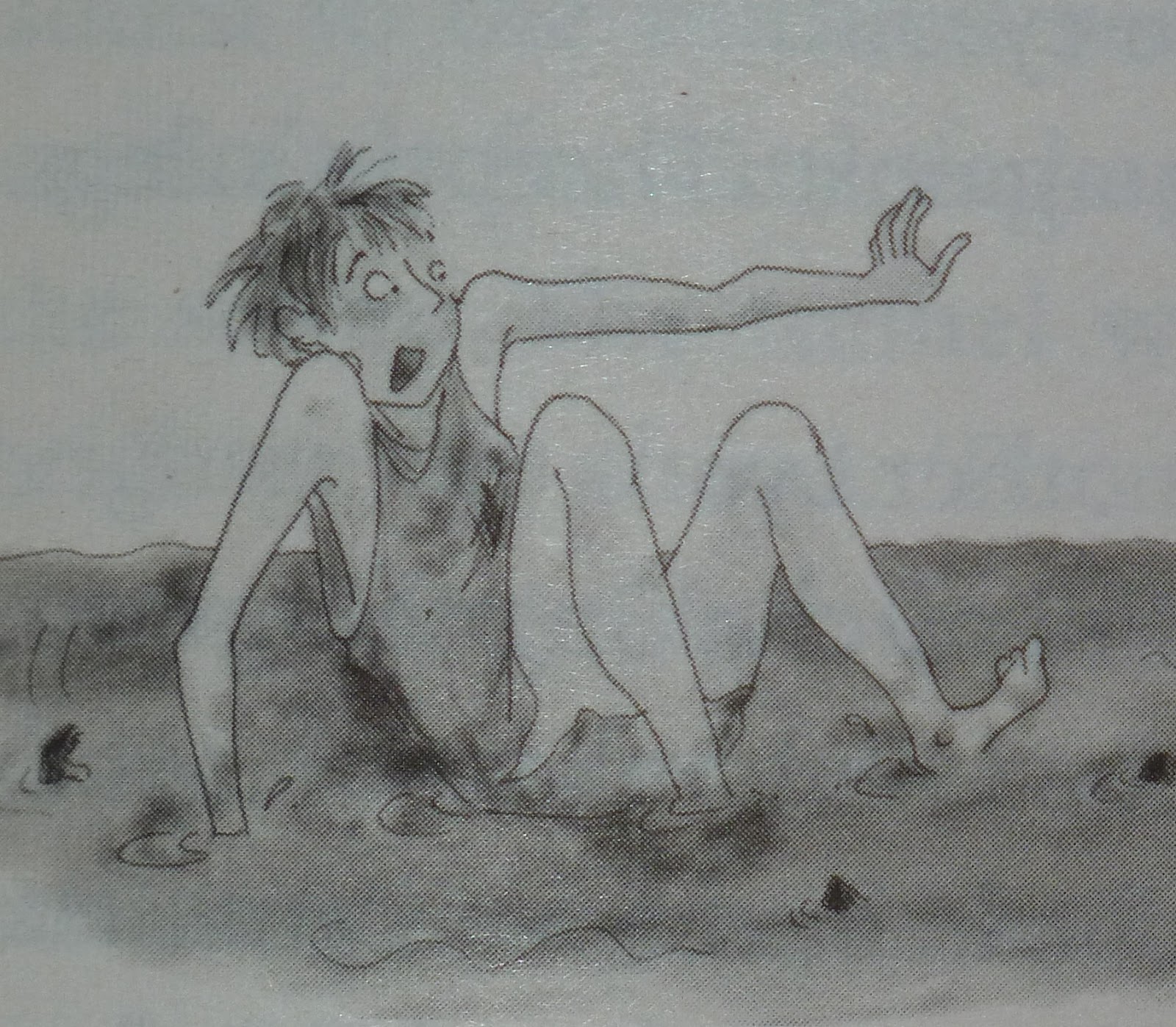
Caroline Lawrence has a wonderful ability to conjure up places and people so well in so few words, and her characters are always so alive they jump off the page. (The little illustrations that accompany each chapter pick up on this brilliantly. Here’s my favourite.) The pacing is spot on, there are no boring bits, and no scene is wasted or ‘filler.’ It’s a very easy read. This would make it a perfect book for younger readers or less confident readers, before diving into the more complex mysteries and plotting of the Roman Mysteries stories. It’s also a great companion book for readers who are already fans of the Roman Mystery world.