Showing posts with label Giveaway. Show all posts

Tuesday, 1 April 2014

Tour of an Exovet Facility - Guest Post by Christian Schoon


Ever wanted to visit an exovet facility? Ever wished you could have a space-hound/alien-cat/amorphous-blob for a pet? (I mean, who hasn't?)

Well, you're in luck. As part of the Under Nameless Stars blog tour, I'm welcoming Christian Schoon onto the blog today. I loved space-vet-in-training Zenn Scarlett's first adventure, and now she's back again in book two! Over to Christian to tell us more about the weird and wonderful animals that an exovet may come into contact with, with a special tour of the Ciscan Cloister facilities!


(And be sure to enter the GIVEAWAY at the bottom of the post, where you can win both books as well as a Name Your Own Star Gift Package!)

---

Hey and thanks to Vicky for inviting me to break into your Earther net-stream for this leg of the Under Nameless Stars blog tour extravaganza. Vicky’s stop on the tour is especially noteworthy for both Zenn and I, since the new novel is officially on sale worldwide today!

So, we’re broadcasting at your now from the com shack here at the ancient Ciscan Cloister Exoveterinarian Training Clinic on the far eastern edge of Valles Marineris, Equatorial Colonial Admin Sector. I’m sure you’ll understand if our signal drops out now and then. You know how tough it’s been to get replacement parts for radios, or pretty much anything else, here on Mars ever since the trade rift with Earth started. Hard to believe that was two decades ago. Anyway, since I’m wearing one of the Cloister’s last functioning screen-sleeve uplink units, we can head outside as we chat. That way you can get a glimpse of the clinic grounds and meet a few of the alien life forms housed here at present.

As we walk over to the main infirmary building, you’ll notice the impressive rock walls on either side of the valley. The red rock cliffs are roughly 1,500 feet high in this part of the Valles, and if you squint you can see the barometric generators mounted on the canyon walls at regular intervals. The transparent membrane of bound-ions these generators produce stretches a sort of invisible “roof” over the valley, trapping air and water vapor inside. It’s thanks to these bary-gens that the valley floors of Mars are inhabitable, and more important, farmable, for the colonists here.

As we approach the huge infirmary building, you can tell by the immense sliding doors that this building is constructed to accommodate even the largest alien animals that are cared for at the Cloister. I’ll just poke my head in and… yes… there’s Otha Scarlett, Zenn’s uncle, at work on a whalehound. The hound is a young adult male, about 80 feet long, something like an over-gown otter, but with eight legs and an elongated snout packed with very long teeth. Otha is using the infirmary’s mechanical lift to raise him high enough to bandage what looks like a bite-wound on the ‘hound’s neck. The animal likely got this while rough-housing with his pen mate, a somewhat larger female. The owners of these two magnificent animals are hoping to get a litter of whalehound pups to take back and release on their ocean-covered home planet. And while the two are a prime breeding pair, whalehounds are reluctant breeders in captivity, so their owners are upping their chances of success by bringing them here, where the Cloister exovets have the expertise needed to encourage the ‘hounds to bond and mate. Whalehounds aren’t especially aggressive, but Otha is using the sedation field dish to calm the animal down as he stitches the wound and applies a coating of derma-plast sealant. The young ‘hound should be well enough to return to his pen, and his rambunctious girlfriend, in a few days.

Leaving the infirmary, we descend a series of stone steps to the area of the grounds where various other aquatic species are housed. Here there is an assortment of pools and holding pens. At the largest pool, we peer into the early morning fog that drifts across the surface and spot Brother Hamish shoveling something into the water from a large wheelbarrow. Hamish is the Cloister’s sexton, or all-round handyman. Or, we should say, handy-bug, since he’s a Sirenian Coleopt, basically an eight-foot-tall sentient beetle. The mist on the water lifts, and a huge, serpentine head emerges, followed by the 200-foot body of a Tanduan Swamp Sloo. The great, plesiosaur-like reptile paddles over to see what Hamish is up to and, once she realizes he’s feeding her, she lowers her tubular nose to the water and begins hovering up the pellets of dried insectoid flakes that he’s dishing out. We wave a greeting to Hamish, who rattles his claws at us in reply, then move along in our tour.

Setting out across the Cloister gen-soy field, we wade through the fragrant blooms of the waist-high plants and are surprised when we suddenly feel what seems like a pair of small, clawed paws gripping one of our ankles from behind. We spin around. But there’s nothing there! Now, we feel the paws clawing at our pants pocket. A moment after that, the air before us shimmers, turns a hazy violet-and-cream color, and then resolves into the shape of what looks like a cross between an Earther raccoon and a lemur, topped by a foxish head with large, tufted lynx ears. It’s the Cloister’s resident rikkaset, Pyewhakit.

Like all rikkasets, Pyewhakit’s fur is made of refractive, crystal-impregnated keratin that allows him to bend light and become more or less invisible at will. It’s an especially effective defense mechanism. Unlike Zenn’s companion rikkaset Katie, Pyewhakit never learned to use sign language. Nonetheless, as he sits up on his haunches and trills at us, it’s clear what he wants. Fortunately, we’ve brought along a handful of dried cat food pellets, which is what he smelled in our pocket. We offer him this, and he gives us a polite lick on our hand before he takes the food in his dexterous front paws and delicately consumes the crunchy morsels.

With Pye trotting along beside us, we reach what Zenn likes to call the Cloister’s “Rogue’s Gallery” of cages, pens and fenced paddocks. Here, a wide variety of alien patients and other long-term “guests” reside. The first large cage seems to be empty, its floor covered by a dense layer of dried leaves, branches and rocks.  I rattle the heavy chain-link fencing and stand back, as the cage’s occupant explodes up out its hiding place, throwing a rain of leafy debris and dust into the air. Pyewhakit fluffs his fur and promptly vanishes from sight. He’s wise to do so. The creature we’ve disturbed is a Sirenian bloodcarn – a thirty-foot, predatory centipede with a head section resembling an immense tarantula. It rears up, hissing as it lifts its bright orange body and hundreds of short, undulating feet up toward the roof of its enclosure. The bloodcarn was purchased from an illegal animal poacher at the black market in New Zubrin. Its owner bought it when it was a barely out of the larval stage, a mere three feet long. The misguided owner thought it would make him look cool to possess such a creature. But as it grew, he  realized he wasn’t prepared to care for a creature as big and vicious as an adult bloodcarn, so he abandoned the animal in a remote canyon, where naturally it came into conflict with the local settlers. After it was re-captured by the authorities, it was brought to the Cloister, where it will now have to live out its life in captivity. It’s a sad story, but people simply seem unable to learn the lesson that some animals do not make good pets and should be left in the wild where they belong. We don’t linger at the bloodcarn’s cage, but move on. After we’ve gone a safe distance, Pye allows himself to become visible again beside us.

We stroll on, passing by the enclosure of a pack of Procyoni yotes – buffalo-sized, hyena-like           scavengers with massive, bone-crushing jaws – then stop to listen to the nesting song of a pair of Akanthan axebill warblers, as the big, ostrich-like birds serenade each other with intricate harmonies that rise and fall as they bob their heads and shake their enormous, red-and-yellow-striped bills in time to the music.

Finally, we loop all the way around to the ruins of the old chapel building, the tiles of its collapsed roof littering the site where it once stood, the huge sandstone blocks of its fallen walls lying in disarray like great dominoes strewn by some giant hand. It was here that Zenn had a truly extraordinary encounter with a young sunkiller being treated at the Cloister. For those unfamiliar, the Greater Kiran Sunkiller is a creature that grows to have a 1,500 foot wingspan, drifting on the air currents of its homeworld like a colossal, two-headed pterodactyl. A birth defect in this particular sunkiller’s wings prevented it from regulating its altitude, and it was brought to be operated on at the Cloister. Unfortunately, just as it was about to be… oh… well, that’s actually quite a long story and we seem to be out of time, as the transmission window for this broadcast is closing. Something to do with upper atmospheric disturbances.

So, it’s time for me to say good-bye. Thanks again to Vicky for letting me give you all this brief tour of the Ciscan facility. And don’t forget to enter the blog tour contest and answer her question about Under Nameless Stars. I mean, really, what Earther wouldn’t want to win free books and a chance to Name Their Own Star?  Signing off from Mars, this is Brother Schoon and the other humans, Alien Sentients and animal guests here at the Ciscan Cloister. Cheers!

---

Thanks Christian! I still really want my own rikkaset...

On to the GIVEAWAY!


To celebrate the publication of Under Nameless Stars, Strange Chemistry is running an exciting competition with a different question at every stop on the tour! You can find out who else is on the tour here.

And you can find out the answers to all the questions by reading this extract of Under Nameless Stars:

Read an Extract:

Read and Share via Issuu.com


So, here is my question:

15. In the opening scene, when Zenn comes to, she's sharing the cage-crate with what other animal (besides Katie and Liam...)?
a. A bloodcarn
b. An indra
c. A sandhog
d. A skirni


Good luck! :-D


a Rafflecopter giveaway

Thursday, 22 August 2013

Guest Post and Giveaway! - Colin F. Barnes: Top 5 Techno Thrillers for a Beginner

We've got Colin F. Barnes with us today for a guest post about Techno Thrillers! A while ago I reviewed Colin's book Artificial Evil, the first in the Techxorcist series, which I loved. Artificial Evil is a great genre-mixing techno-thriller-dystopian-cyberpunk-science-fiction-adventure, and it's a lot of fun!

And... you can win a copy! Enter the GIVEAWAY (open INT) at the bottom of this post for a chance to win a paperback copy of Artificial Evil.


So what's a techno thriller and where do we start? Over to Colin!

---

What is a Techno Thriller?


You’ll likely find a wide spectrum of titles that are considered to be among this genre, however, they all share a few things in common, such as: a propensity for technology as a central element to the story and a large proportion of technical detail within the narrative, whether that be military, science, or even politics.

The genre doesn’t tend to go into the future as the lines blur into science fiction. There’s a large crossover between a techno thriller and action/adventure, as the plots tend to have high stakes, world-endangering catastrophes, and larger-than-life characters.

Techno thrillers are one of the few genres that manage to bring speculative fiction to contemporary settings, and it’s that key component that makes it stand apart. In science fiction, one of the big drivers is the ‘what if’ game. It speculates on the outcome if ‘this’ or ‘that’ happened. This can also be seen in fantasy and especially alternate history: what if Hitler won the war being a common example.

With regards to science fiction, there is a slight blurring of lines when it comes to near-future fiction. They are, in my mind, the same thing across a spectrum of time. The further into the future you go the more ‘SF’ it becomes. There’s a crossover somewhere in the middle where technology is being developed now that will continue to exist and evolve into the science fiction of the future.

I write in that blurred area. I tend to write my fiction either now, or within a hundred or so years. That’s what I consider near future, and thus my work straddles the line of contemporary techno thrillers and near-future science fiction. It’s a fertile ground to work within as it can blend the best of both worlds.

So now you know what a Techno thriller is, I’ll run down my favourite five to give you a kick-start in the genre. These are what I consider either cornerstones of the genre, or particularly fine examples for someone new to the techno thriller.

No.1 Jurassic Park – Michael Crichton


Crichton is the boss of this genre. His body of work serves to illustrate the genre at its finest, combining both the technological aspects with real thrills. It’s no surprise that a number of his titles made it to the big screen.

Jurassic Park, and the follow up The Lost World, primarily covers the technological aspects of cloning, chaos theory, and evolution. The thriller aspect is delivered by freaking huge dinosaurs chasing humans around the island for a meaty snack. Not to mention the sneaky, clever raptors. If you’re new to this genre, start here. You’ll most likely be familiar with the film, but like most translations, the source material is far superior.

No. 2 The Hunt for Red October – Tom Clancy


Here we have another film adaption, which is no surprise really. Techno thrillers lend themselves perfectly to film what with their high stakes, action, suspense and cool technological gadgetry. Many will remember the film for Sean Connery’s shpectacularly Scottish Russian accshent. Nishe job, Sean.

For those who have not seen the film, it’s a taut suspenseful story of a stolen Russian nuclear submarine. This one blends technology with both the military and politics, giving a well-rounded account of the main tropes of the genre. It’s also, in my opinion, one of Clancy’s best books, written before he took the James Patterson style of farming out his work to ghost writers.

No.3 James Rollins - Sandstorm


Rollins heads up the action-adventure corner of the genre. He also manages to interweave historical elements and mysteries with the technology, using the latter often as a way of explaining the mystery. It’s a great formula, and Rollins does it brilliantly. As an aside, he once mentioned that he used Jurassic Park as manual on how to write a thriller. And it shows, not in that he’s copied Crichton’s work, but has developed an accomplished style to bring the thrills and the technology together in an exciting adventure.

Sandstorm is the first of his Sigma Force series of novels. They are a group of specialists working for a governmental department to solve technological mysteries and prevent the bad guys from getting hold of them. A regular cast of characters feature throughout the series. This particular story combines ancient lost cities, museum curators, archeologists, ninjas, assassins, and a potentially deadly source of antimatter, which is at the heart of the story.

It’s a fun read, appealing to the Dan Brown fans, but IMHO is far better written in almost every aspect and nails the adventure part of the techno thriller. It has echoes of Indiana Jones if it were set in modern times.

No.4 Daemon + Freedom TM – Daniel Suarez


Here I’m mentioning both books because frankly, I’m sure they were one story. The ending to the first book is so abrupt you’ll likely throw it against a wall, but don’t fear. Have the second book ready to go straight away and you’ll love this story.

Suarez brings us right up to contemporary times with this story centered on computer technology, hacking, and automation of computer networks. It presents a terrifying, but plausible (to a degree), ‘what if.’ A leader computer programmer is found dead. However, his will lives on within a computer network running a number of automated tasks programmed ahead of time. This makes the detective’s job increasingly difficult, as it seems he’s one step ahead of them, and all the while, this automated post-human program is organizing an army of followers.

Suarez’s writing is excellent. He tackles what could be quite a dry, technical subject and turns into a ‘can’t stop turning the damn pages’ thriller that will grip you until the end. He weaves in a deep mystery that keeps you guessing, and his ideas are innovative and creative. Definitely one for the computer nerds out there, but it’s still accessible enough for the average reader.

This particular book was one of my main influences when I started to write my Techxorcist series of novels, which cover computing, artificial intelligences and uploaded consciousness. Although Suarez’s books are set in contemporary times, it’s easy to extrapolate those into a near future story such as my series.

No.5 The Bourne series – Robert Ludlum


I’ve chosen these as a series rather than focusing on an individual book, because together they cover the complete arc of the story. Another film adaption, again, showing the great visual potential that a techno thriller has, the Bourne books are slightly less technical in terms of technology, but cover the thriller aspects of sciences such as mind control, memory manipulation and social and personal conditioning.

Like The Hunt for Red October, it takes a governmental/political look at the genre with Jason Bourne at times being hunted and taking the role of the hunter as he seeks to find the truth of the secret program that made him what he is.

Lots of thrills and intrigue, layers of mystery and subterfuge. They make great books and great films. What’s not to love?

So there we have a very brief look at the techno thriller genre, and I hope with these examples you’ll be tempted to dive in if you haven’t already. It’s a wide genre covering a lot of diverse topics. There’s something for everyone: action, adventure, politics, science, and history. For me, it’s the most fertile contemporary genre around and the boundaries are wide enough to never get bored.

Give one a try today, I’m sure you’ll love the experience.

For more recommendations, Wikipedia have an excellent list here.

---

Giveaway!


Enter the rafflecopter form below to win a paperback copy of Colin's techno-thriller novel, Artificial Evil. Open INT and no following required (though certainly appreciated, if you want to!). :-)

a Rafflecopter giveaway


---

About Colin F. Barnes

Colin F. Barnes is a publisher and full-time writer of horror and techno thrillers and a member of both the British Fantasy Society and the British Science Fiction Association. He honed his craft with the London School of Journalism and the Open University (BA, English).

Colin has run a number of tech-based businesses, worked in rat-infested workshops, and scoured the back streets of London looking for characters and stories—which he found in abundance. He has a number of publishing credits with stories alongside authors such as: Brian Lumley, Ramsey Campbell, and Graham Masterton.

Colin’s Books:

ARTIFICIAL EVIL: Book 1 of The Techxorcist.
THE DAEDALUS CODE: A Novella

For more information, Colin can be found on:
Twitter
Facebook
Amazon
His Website


Friday, 1 March 2013

Fire and Ice – Romances That Melt The Ice, and GIVEAWAY


The Fiery Hot Reads for Icy Cold Nights blog tour is an event organised by Rainy Day Ramblings, Cambria Hebert, Love of Books, Kimba the Caffeinated Book Reviewer, and Mostly Reviews. It’s been running from Jan 28th and today is the LAST DAY!


This is a post all about those romances that start with icy hate or enmity, or differences that are seemingly too big to overcome, but turn to love so strong it melts the ice. These aren’t the slow friendship-turned-to-love romances (though I do love those)... this is a post for the you-drive-me-crazy ones, the I-was-so-wrong-about-you ones, or the I-know-shouldn’t-but-I-could-never-stop-loving-you ones.

Now, there are a lot of really great hate turned to love classics, and I could easily have filled the list with them, but I wanted to mix it up with a bit of variety... with some well-known books, some old, some new, and some that many will never have heard of. Hopefully there will be something that everyone recognises on the list, as well as something completely new. Naturally, there may be a few minor spoilers for the books listed here (such as who ends up with who!), but hopefully nothing too big.

Oh, and check out the giveaway at the end of the post too!


This is really the definitive book for the hate turned to love romance. Lizzie can’t stand Mr. Darcy at first, and he certainly thinks himself above her. Their conversations are definitely icy. At first, Mr. Darcy falls in love despite his better judgement, despite her low station compared to his. Lizzie points out that this isn’t enough, that his attitude could never inspire love in return. But Mr. Darcy doesn’t give up; he listens to everything she says and realises the truth behind it. He changes, but he also reveals more about himself to Lizzie, and slowly she begins to see that she judged him too quickly. Both of them are forced to change their minds, and both to see the other in a new light as their love begins to melt away the ice.


If Pride and Prejudice is the definitive hate turned to love romance, then Romeo and Juliet is definitely the definitive love defies all obstacles romance. It’s one of the most famous of all love stories and has been re-imagined in so many different ways, from West Side Story to Underworld. Romeo and Juliet are from rival families and their love is doomed from the start, but that doesn’t stop it from burning fiercely, defying everything thrown at it before its tragic end.


Anne really doesn’t like Gilbert; at school he makes fun of her hair colour and she smashes her writing slate over his head. But there’s something there, a spark between them that turns first into friendship, then into a deep love that weathers every storm.


I actually haven’t finished this series yet, but it strikes me as a beautiful example of the I-shouldn’t-love-you-but-I-can’t-fight-it kind of romance. Ash is a prince of the Winter Court, and Meghan is the daughter of the Summer King; they are age-old enemies and Ash has been tasked with capturing Meghan. He didn’t realise he would fall in love with her...


Sophie doesn’t trust Howl. She thinks he’s an evil wizard who literally eats young women’s hearts. Then she meets him and finds out that he’s just a self-absorbed jerk with an eye for the ladies and an obsession with his hair-care. Which is almost as bad. It takes Sophie a long time to see that she's fallen completely for Howl, and it takes even longer for him to admit his own feelings for the bossy woman who cuts up his shirts. Sophie and Howl drive each other crazy, but their love is strong enough to battle anything.


Whether you’re a fan or not, this is a great example of a romance that works despite seemingly insurmountable differences. Not only is Wanderer a different species that looks more like a little insect thing than a person, she’s part of the invading race who are literally obliterating humanity. She’s also inhabiting a human body that belongs to Melanie, who’s in love with a different guy. Oops. But Ian and Wanderer’s love conquers the enmity and suspicion, and as revealed in the quote above, Ian loves her for who she is, no matter what she is.


This was a really recent read for me and i loved it! Elena and Clay are constantly at each other, whether it’s arguing, throwing around insults, scrapping as werewolves, or having passionate sex. Elena cannot forgive Clay for something he did to her in the past, and she tells herself over and over that she hates him. It’s soon obvious that Elena’s hate is wound up with a deep love that will never burn out. And Clay is determined to do everything he can to win her over. This romance had an added bonus for me – I wasn’t rooting for it at first, but then it won me round too. Their love can even melt the reader’s ice!


 ---

And now for the...

GIVEAWAYS!


I'm giving away your choice of one of the books mentioned (or any other book that you think might have a 'romance that melts the ice' in it - your choice) up to the price of £8 (UK pound). Open worldwide as long as the Book Depository ships free to your country.

Aaaaand... for a second winner I'm giving away a little goody package of romance-themed stuff. Sadly, postage costs mean I can only open this one to the UK.

No following necessary, though always appreciated and rewarded with imaginary cupcakes. ;-)

Congrats to winners Samantha Stewart and Angela C! 

a Rafflecopter giveaway

Hope you enjoyed the post, and be sure to stop by Mostly Reviews for Veronica's post too!


(Thanks to ArsGrafik, Gangstarr71, and Shiranui for photoshop brushes used)
 

Sunday, 3 February 2013

Showcase Sunday #4


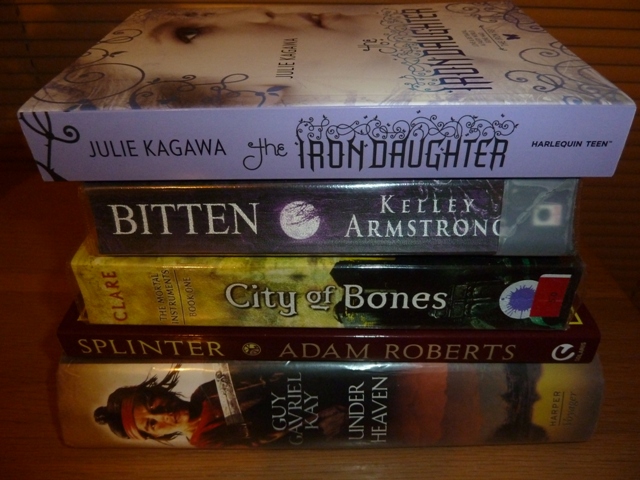
Inspired by Celine from Nyx Book Reviews, I've decided to combine several book haul memes into one post. Welcome to... Stacking the Showcase Sunday Post Shelves with Letterbox Love!

Showcase Sunday is hosted by Vicky at Books, Biscuits and Tea. Stacking the Shelves is hosted at Tynga's Reviews, and Sunday Post is hosted at Kimba the Caffeinated Book Reviewer. Letterbox Love is a special British book-haul meme hosted by Lindsey at Narratively Speaking.


 My First GIVEAWAY!


Have you entered my FIRST EVER GIVEAWAY yet? You can win a copy of The Aylesford Skull, the first steampunk novel in 20 years from James Blaylock, one of the founding fathers of steampunk! This is part of Titan's The Aylesford Skull Swashbuckling Book Tour.

You can enter on the REVIEW post or the INTERVIEW post.
(open worldwide!)


 This Week's Goodies


Library books, charity shop, and one present:


Ebooks:


Thanks to HarlequinUK and NetGalley for the review copy of Dash and Lily's Book of Dares.


 Books Read Last Week


Last Week on the Blog


The Aylesford Skull - Book Review and Giveaway!

James P. Blaylock, steampunk legend - Interview

The Iron King - Book Review

Top Ten Tues - Most Frustrating Characters

The Pros and Cons of Being a Gaming Couple

Darksiders II  - Game Review

I signed up for February's Review Copy Clean-up

I made a book poem for the TBR Pile Challenge


Other Stuff


I signed up to take part in the Fiery Hot Reads for Icy Cold Nights blog-hop event. Be sure to check here on March 1st for my post and giveaway, which will be about... Romances That Melt The Ice!


Monday, 28 January 2013

James P. Blaylock Interview and Giveaway


James P. Blaylock is regarded as one of the founding fathers of Steampunk, as well as being the winner of a Philip K. Dick award and two World Fantasy Awards. The Aylesford Skull is his first full-length steampunk novel in twenty years! You can read my review of the book here.

James kindly agreed to stop by and answer some questions about his writing and his latest exciting book.

(There are also two chances to WIN A COPY of The Aylesford Skull, one of which is a limited edition signed hardcover, so be sure to check that out at the bottom of this post!)

---

Hi James! How does it feel to be called a ‘father of Steampunk’?

It makes me feel quite nice actually, although if I’m in fact the father (or grandfather, according to Locus magazine) then I share the honor with Tim Powers and K.W. Jeter. We were all writing Steampunkish stories and novels and hanging out together in the 1970s. I had the distinction, such as it was, to publish a Steampunk short story, and not long after that K.W. published his novel Morlock Night. K.W. also coined the word “Steampunk,” although not until 10 years later, when it had taken on the trappings of a subgenre. By that time the three of us had published a number of Steampunk novels and short stories. We were all influenced, of course, by other writers and by each other. Questions of origin are always murky. I’m happy to think that the rise of Steampunk culture, so to speak, was due to the three of us. What would have happened, I wonder, if we had been busy writing books about hedgehogs. Hedgepunk?


What is it that attracted you to Victorian England? What made it an interesting setting to write about?

I was and am attracted to Victorian England for two reasons. The first is that the era was wildly colorful; it produced amazing art, furniture, fashion, and a thousand and one other cool-to-look at and read about things. It was a very rich period, culturally speaking, (and was also a gritty, impoverished, cruel, and enormously fascinating era in other ways). It arguably produced the greatest literature of any literary period anywhere in the world, which is the second thing that attracted me to it. When I was ten years old, I read Verne and Wells for the colorful, adventurous elements of their books. I was big on illustrations of finny submarines and archaic looking rockets built by backyard explorer-scientists wearing beaver hats. Later, when I read Dickens and Tennyson and Ruskin, I developed a love of the language, while increasing my attraction to the nifty stuff of the period. I’ve never lost any of that, I’m happy to say, and so I take the same pleasure in writing about the era today. I’m going to bet that Steampunk readers and writers and artists and costumers would say something very similar. I’m not at all surprised at Steampunk’s broad appeal.


One of the things I really liked about the book were the little eccentric, supernatural details, like the skull lamps, the corpse candles, the pagan graveyard buried deep under London, etc. Are any of these actual myths or stories from Victorian times, or did you invent them? What gave you the ideas for them?

Although I invented the incidents of the novel, many of the elements that you mention I simply found doing casual reading or while doing research: the corpse candles, for instance, the subterranean graveyards, the old smugglers inn hidden in the marsh below Egypt Bay, etc. The skull lamps were a product of my fascination with Japanese magic mirrors. I thought a lot about how to turn the interesting but innocent magic mirrors into something more sinister, and what came of that were the skull lamps. Thinking all of this through led me to articles on early photography and coal dust explosions and a plethora of other things. That’s the problem (or perhaps pleasure) of writing stories that requires research, one thing inevitably leads to another. There’s virtually no limit to the things you can discover, although there’s an absolute limit to the things you can actually use in your book.


I thought all your heroes seemed like very real people, each with their own little quirks. Do you ever see yourself in any of your characters?

All of my protagonists are constructed of pieces of me, so to speak, although ultimately they resemble me in over-the-top ways. Their eccentricities are inflated examples of my own eccentricities, and their weaknesses and enthusiasms are exaggerations (usually). I don’t engage in adventurous behavior, so I’m thankfully not called upon to be heroic, or to shoot people or to be shot. All that being said, in some sense I always write about what I know, and my characters are often very much related to people I’ve known or that I know, including myself. I’m fond of the quirks and oddities that differentiate us from everyone else, but I’m not fond of sword wielding heroes who have no reason to sometimes be unhappy with themselves. (Lots of weird negative constructions in that sentence, not to mention the split infinitive. Hope it makes sense.)


So I’m assuming the character Arthur Doyle is the Arthur Conan Doyle. Why did you decide to include him in the story?

Arthur Conan Doyle
He is indeed Arthur Conan Doyle. On a whim I bought a biography of Conan Doyle, which I was reading at about the same time that I was reading about early photography. Conan Doyle (merely Doyle back then) was an avid amateur photographer, and the more I read about him, the more interesting he seemed to be, for reasons that had nothing to do with his Sherlock Holmes stories. At the time The Aylesford Skull takes place, Doyle would have been about the same age as Jack Owlesby, who is a character in all of my Langdon St. Ives books and stories, and in fact narrates many of them, in which case he functions as my Watson, in his small way. Doyle was just starting to write and publish short pieces, as was the fictional Jack Owlesby. It seemed right and natural that Doyle should be a character in the book, as long as he remained a peripheral character. I had the idea that if he became cumbersome, I’d simply cut him out. That didn’t happen. More on the Conan Doyle influence below.


Who are your biggest writing influences or favourite authors?

My favorite authors are most often also my biggest influences. When I was ten years old I started reading books from my mother’s library, and at that same time I began to receive books as gifts at Christmas and on birthdays from relatives who weren’t themselves readers. This deluge of books was a plot, in other words, fomented by my mother.

One of the earliest books I remember reading was The Return of Sherlock Holmes. I had no idea who Conan Doyle was, or Sherlock Holmes, or that Holmes had anyplace to return from. I loved the foggy mystery of the stories, however, and it didn’t matter a bit that I couldn’t understand parts of them. (I was also trying to read Walter Scott; “The Adventure of the Empty House” was a cinch compared to Ivanhoe. At the same time, I found half a dozen Steinbeck novels and story collections among her books and read them. I was particularly fond of In Dubious Battle, which was a weird thing given my age. I read it three or four times. I was so smitten by the language and settings that I launched endless copycat Salinas Valley stories that went nowhere. My uncle and aunt gave me the collected short stories of Mark Twain at about the same time my parents gave me Tom Sawyer and Huckleberry Finn. My enthusiasm for books was pretty much solidified by that time, so my mother hauled my sister and I down to the local library once a week after school, and over the next couple of years I read through Verne and Wells and Burroughs and the seafaring novels of a writer named Howard Pease.

By the time I was thirteen I had read virtually all of the books that would become the most influential to me as a writer, and my brain was so full of Victorian and Edwardian science fiction stories that I was virtually condemned to write what became Steampunk. The biggest influence on my writing, however, were the stories and novels of Robert Louis Stevenson, which I read in my early twenties. At that same time Tim Powers gave me some P.G. Wodehouse to read, and it was this weird mixture of Stevenson and Wodehouse that inspired “The Ape-box Affair,” my first Steampunk story. My novel Homunculus was heavily influenced by Stevenson’s New Arabian Nights and by The Strange Case of Dr. Jekyll and Mr. Hyde. The Wind in the Willows (along with Huckleberry Finn) inspired The Elfin Ship, my first novel.


What do you think of where Steampunk has gone in the years since you first started writing it? Is there anything you particularly love or dislike about the Steampunk craze?

Steampunk Jewellery (sodacrush)
I’m completely in favor of Steampunk going anywhere and everywhere. I recently heard that people are writing Steampunk porn, and that seems a little bit sketchy, not to mention cumbersome, but I’m amazed and elated to see Steampunk leaking into fashion and architecture and film, etc. One nice result is that the market for Steampunk books is more solid than ever (although I’ll continue to write the stuff whether or not there’s a market for it. Better a good market than a bad, certainly.) There’s not much about the Steampunk craze that I dislike, except for those things that I dislike about all crazes, especially the production of derivative, unimaginative, bandwagon, shoddy things that fly under any suddenly fashionable banner.


Are there any more Langdon St. Ives books to come? What’s next for you?

There’s a Langdon St. Ives book in the works, in fact, The Pagan Goddess, a companion volume to two previously published short novels, The Ebb Tide and The Affair of the Chalk Cliffs. At the moment there’s yet another St. Ives novel whirling around in my mind. Ideally it’ll quit whirling sometime soon so that I can see it clearly enough to get started writing it. I’m also quite happy with my novel Zeuglodon, the True Adventures of Kathleen Perkins, Cryptozoologist, which came out a few months ago. I’m currently working on a sequel to that one, and having so much fun with it that I’m contemplating writing more of them. Who knows how many?

Thanks, Jim.


Thank you for stopping by James!

(Is it just me, or does anyone else kind of want Hedgepunk to be a thing?)


---

GIVEAWAY!


This Giveaway is now closed. Congrats to Katrina Day-Reilly, who won a copy of The Aylesford Skull!


I’m giving away a paperback copy of The Aylesford Skull to one lucky winner. Just fill out the rafflecopter form below and good luck! Giveaway open worldwide. 


Thanks to Titan Books for providing this giveaway copy!


a Rafflecopter giveaway


The Aylesford Skull - Book Review and Giveaway


The Aylesford Skull, by James P. Blaylock: It is the summer of 1883 and Professor Langdon St. Ives - brilliant but eccentric scientist and explorer - is at home in Aylesford with his family. However, a few miles to the north a steam launch has been taken by pirates above Egypt Bay; the crew murdered and pitched overboard. In Aylesford itself a grave is opened and possibly robbed of the skull. The suspected grave robber, the infamous Dr. Ignacio Narbondo, is an old nemesis of Langdon St. Ives.

When Dr. Narbondo returns to kidnap his four-year-old son Eddie and then vanishes into the night, St. Ives and his factotum Hasbro race to London in pursuit... (synopsis from Goodreads).
 ---

James P. Blaylock, one of steampunk’s founding fathers... winner of a Philip K. Dick Award and two World Fantasy Awards... his first full-length steampunk book in twenty years... another in the famous Langdon St. Ives series, pitting hero-inventor-explorer against his evil arch-nemesis Dr. Narbondo. When Titan Books asked if I might like to review this book, I may have fallen off my chair.

First off, is it necessary to have read the other Langdon St. Ives books to enjoy The Aylesford Skull? No, absolutely not. The story stands alone very well, and the plot and great characterisation convey the history between St. Ives and Narbondo perfectly, as well as St. Ives’ relationship with other characters, too. And readers who are familiar with St. Ives are also sure to find plenty to enjoy.

As you might expect with a steampunk story, The Aylesford Skull has a really good sense of setting. London, in particular, feels very real, from its respectable establishments to its grimy and dangerous back alleys, and the author uses various locations in spectacular ways throughout the plot. It’s also not as overtly steampunky as you might expect. The place isn’t packed with cogs and goggles and clockwork and strange puffing machines, but instead blends the fantastic with the real in more subtle ways. Things like the skull lamps, which to me instantly conjure up that Victorian obsession with science and the macabre, and the odd way in which the rational and irrational often became blurred. It feels like something that really could have existed. If steampunk is often a genre packed with things, the things in this novel always feel realistic and serve the plot.

The one exception is the airship, which felt as though it had been shoehorned into the story in order to add this vital steampunk touch. Sure, everyone loves a blimp, but I did think it was misplaced here. There were times when Langdon St. Ives genuinely seemed more interested in his invention than saving his son, and I did not understand why he felt the need to fly it to London while his friends took a perfectly serviceable train and still arrived there first.

This was a small hiccup in otherwise brilliant character writing. I loved St. Ives and his friends, particularly how each ‘sidekick’ to the hero was given specific traits and tasks. Everyone got a chance to shine, and St. Ives by no means took on all the most glorious adventures. In fact, if there was a real hero in the book, for me it was Finn. This was refreshing, as often the side characters only seem to be hanging around to make the hero look good. Either that, or the hero gets some foolish notion that to be a true hero he or she must do things alone. Not St. Ives... he goes straight to his friends for help, and that’s a character I can really support.

The villain Dr. Narbondo (great name), and the plot in general, were not quite as strong. I wasn’t sure about Narbondo; he was perhaps a little too one-sided – Evil with a capital E – a traditional black-clothed villain who kidnapped and killed children, wanted to open a path to the land of the dead, and even had a hunchback. However, this did add a sense of melodrama to the story, which actually complemented the Victorian setting very well. Everything about Narbondo and the plot was a little larger than life, and since this feeling ran throughout the whole book, it gave it a fun – if somewhat clichéd – atmosphere.

In terms of the plot, there’s kidnapping, chases, fights, more chasing, more fights, creeping through London’s seedier streets, infernal devices, murder, treason, daring rescues, more chases, even bigger fights! There’s certainly no lack of excitement, and as soon as St. Ives (rather inexplicably) gets into that airship, you just know it’s going to be one heck of a showdown (and it is). It’s entertaining stuff, but – slightly disappointingly – it never moves beyond ‘fun’ into something a bit more subtle or really breathtaking. And because of that, parts of it felt a little flat to me. For a light-hearted, exuberant and fun read, however, this book does the trick.

Thank you to Titan Books for providing a review copy of this book in exchange for an honest review.

Giveaway


This giveaway is now closed. Congrats to Katrina Day-Reilly, who won a copy of The Aylesford Skull!


a Rafflecopter giveaway