Monday, 23 July 2012

White Cat - Book Review

 
White Cat, by Holly Black, tells the story of Cassel Sharpe, a teenage boy from a family of curse-workers. Cassel has always felt alienated, neither curse-worker nor ‘normal.’ His mother is in prison, his brothers either absent or indifferent, his father dead, and the fellow boarders at his school mistrustful. Worse than this, he lives with a terrible secret and struggles every day to face the crushing guilt it causes. When he begins sleepwalking and a strange white cat visits him in dreams, he starts to unravel a sinister plot, as well as some shattering truths about his family and his past.

White Cat is a dark, witty and entertaining story set in an alternate universe in which a form of magic known as ‘curse-working’ exists openly. Those who can’t curse-work are suspicious of those who can, and the curse-workers are considered dangerous – little more than criminals. Laws have been put in place prohibiting curse-work, which do not distinguish between the bad (killing, injury, manipulating memory, etc) and the good (bestowing good luck, using emotion-work to help heal people, etc). This means that the curse-workers are often manipulated or threatened into a life of crime, or driven into it by desperation.

Sunday, 22 July 2012

The Fish who had Funny Eyes, and Other Stories...

My dad is moving house soon, so I've been looking through numerous boxes of old things. Old books, letters, UCAS forms, photos, beady-eyed cuddly animals, and so many memories... I'll be walking around in a little cloud of nostalgia for weeks! In between all the rummaging and amongst the old toys, I found one of the first stories I ever wrote:

The Fish who had Funny Eyes


Once a fish gave someone a fright, and she ran away. The girl told her dad and he came down the path to the pond. "Help!" yelled her dad, and they both ran away back up the path.


Her dad told her mum, and they all walked down the path to the pond. "Help!" yelled mum, "let's go!" So they ran back up the path and into Granny's house.

Sunday, 15 July 2012

Edge Lit - Convention Report

Edge Lit is a new convention for writers and fans of SF&F and horror, held in Derby (UK) and run by Alex Davis. This year’s Edge Lit took place yesterday, on Saturday 14th July at The QUAD, Derby.

With all kinds of authors and publishing professionals present, eleven different panels and talks, seven workshops, and fourteen author readings, Edge Lit was a packed and exciting day. Unfortunately, one of the guests of honour, Geoff Ryman, couldn’t make it, but Graham Joyce stepped in and gave a very interesting Question and Answer session.


Monday, 9 July 2012

Mass Effect 3 Endings Post Extended Cut DLC - What's the Right Choice?


So, following on from my review of the Extended Cut DLC for Mass Effect 3 (read it here), I wanted to discuss the (now four) different endings in a little more detail, taking into account how the Extended Cut has affected them. Warning – this will be a LONG post. When I mentioned all the speculation in my bio, I really wasn’t kidding. 

Obviously, massive spoiler alert! I'm going to talk about the ending to Mass Effect 3 in depth, Extended Cut DLC included, so if you haven't played it yet, get away now while you can!

Saturday, 7 July 2012

Mass Effect 3 Extended Cut DLC - Game Review


It’s pretty hard to avoid spoilers while reviewing an extended cut of the ending of a major game, so if you haven’t had a chance to play the Mass Effect 3 Extended Cut DLC yet, be warned that spoilers are going to abound. Bookmark this page and come back when you’ve experienced the new ending ;-)

Mass Effect 3 had one of the most controversial endings ever, certainly in video gaming history. Many (the majority of?) fans disliked it, and the backlash was so strong even Forbes covered it. Reactions ranged from well thought out criticism, to the absurd (but funny), and even some pretty excessive hate.


Wednesday, 4 July 2012

Hufflepuff Love - Sorted This Way


Image by Jmh2o (Wikimedia Commons)
I just found something awesome I'd like to share - this Hufflepuff Pride Video on YouTube.

I’m a huge fan of Harry Potter (books and films), but there has always been something about the world of Hogwarts that I find slightly disturbing. And that’s the house rivalry. Splitting students into houses is pretty common in British schools (I’m not sure if this happens in other countries so much?), but this is clearly not a good idea where wizards are concerned. House rivalry is supposed to encourage healthy competition and working in teams, but when ‘competition’ involves the power to blow things up, perhaps the wisdom of this needs reconsidering. Particularly when the school decides to give each house its own common room in what seems like an attempt to actively discourage the different houses from socializing after school hours. Why this pointless factionalising wasn’t trashed after the whole Voldemort thing is beyond me. Why exactly do they want to be encouraging more rivalry and prejudice in the wizarding world? And why oh why at the end of the seventh book is Harry Potter encouraging his own child to engage in it? After everything he’s seen?

Saturday, 30 June 2012

Zoo City - Book Review

Zoo City also has one of the best covers I've seen

Zoo City is an Arthur C. Clarke Award-winning urban-fantasy book by Lauren Beukes. It tells the story of Zinzi December, an ex-journalist and recovering drug addict who became ‘animalled’ after her actions led to her brother’s murder. Now she carries around a sloth, as well as a nasty drug-money debt and a lot of guilt. The day she gained Sloth she also developed a new, magical talent for finding lost things. When she is hired to locate a missing girl, one half of a famous teen pop duo, the case begins to lead her to darker and more dangerous places than she had expected.

Zoo City was not quite what I was expecting, but then, I’m not entirely sure what I was expecting. Perhaps something in which the fantasy or science fictional element was more prominent, not necessarily the focus of the plot, but at least more central. In this, the animals, the magic, the strangeness, are all just there, while Zinzi gets on with things. But you know what? This is a large part of what makes Zoo City so brilliant. Not only are the magical elements never fully explained (which I often prefer anyway), they are not even really important. Except that they are, just not in the ways the reader might think. Animals and the consequences of being animalled are vital to the characters and their world, as well as allowing the author to explore ideas of prejudice, guilt and the stigma attached to rehabilitated criminals, amongst other issues, without ever becoming preachy or heavy-handed. Each element that makes the world strange – the animals, the undertow, the mashavi – is revealed almost as a mundane detail in the background while the missing-person mystery takes centre stage. And then, suddenly, all these little details become vital as the plot takes a darker turn, and the existence of the animalled becomes central to the story after all. This seems like a risky approach, but it is a risk that really pays off.

Thursday, 21 June 2012

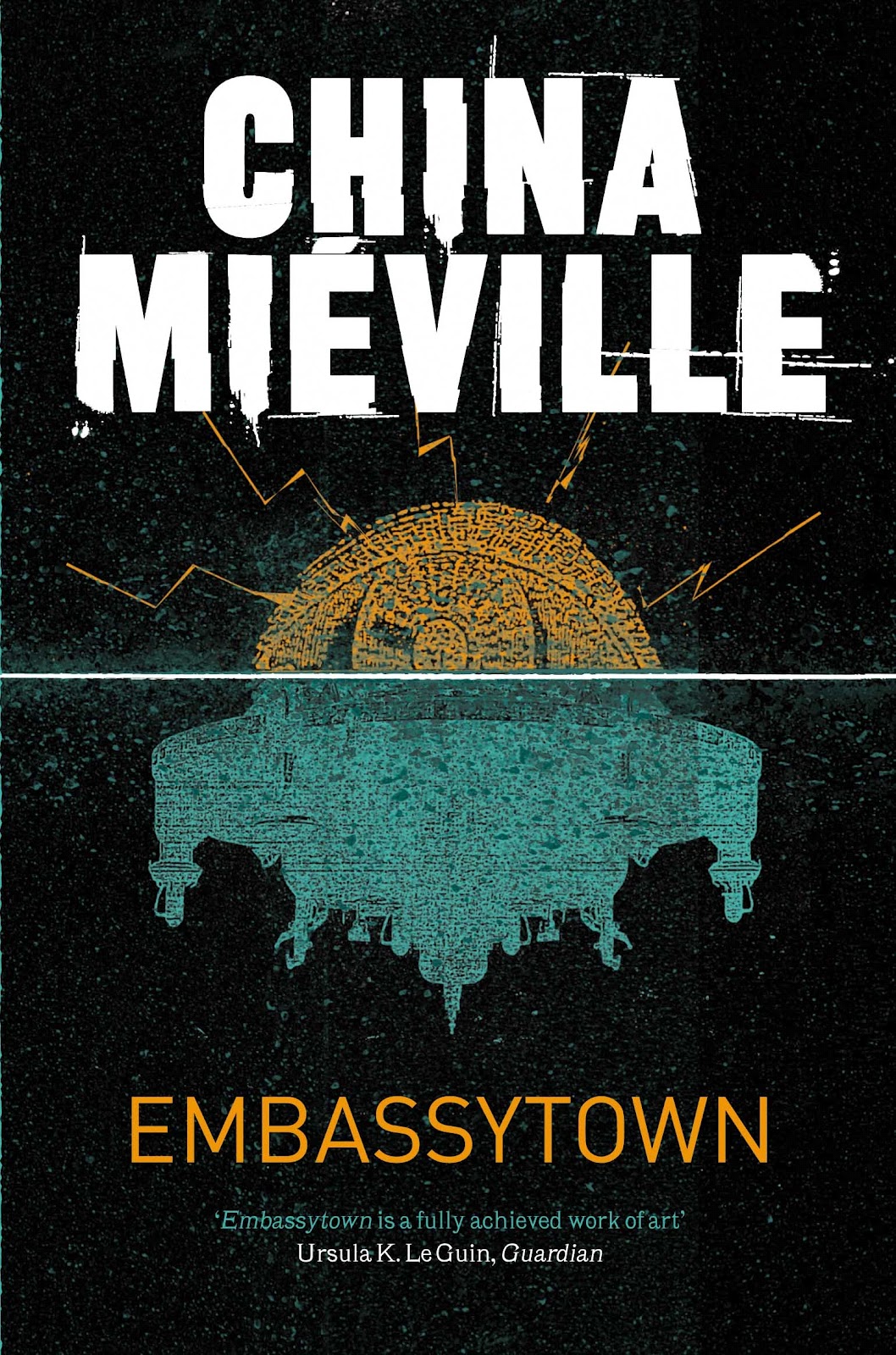
Embassytown - Book Review


 Embassytown has just won the 2012 Locus Award for Best Science Fiction Novel. In his thank you message, China MiĆ©ville described the book as a homage to some of the science fiction authors he grew up with and was influenced by, including Ursula le Guin, Robert Silverberg, Gene Wolfe, Octavia Butler, Samuel Delany, Michael Moorcock, Brian Aldiss, and Joanna Russ. This is quite a lot for Embassytown to live up to, but thankfully, it really does. (And I say that as a complete unashamed fangirl of Ursula le Guin, whose review was one of the main reasons I decided to read the book.)

Embassytown, by China MiĆ©ville, is a science fiction story about human interaction with an alien race called the Ariekei, whose Language (capitalised here on purpose, as it is in the book) is very different from any human language. The Ariekei, “insect horse coral fan things,” speak with two mouths but one consciousness, and they cannot lie. In fact, they cannot speak in, or seemingly even perceive of, abstractions. This makes communication extremely difficult, sometimes all but impossible. Only specific humans – the Ambassadors – can speak Language, and so all interaction with the Ariekei must go through them. One day, sent by Embassytown’s suspicious mother-planet, a strange and impossible new Ambassador arrives to speak to the gathered Ariekei diplomats. The consequences are unexpected, and devastating.

This is a book about language and its complexities, but also about the disturbing and shattering effects one society can have on another, the clash of two very different cultures, imperialism and power politics, and a colony struggling to find its independence. Finally, it is about the breakdown of the Ariekei culture, the attempts of the humans to prevent this for various reasons of their own, the Ariekei struggle to change their often simplistic worldview in an ever-increasingly complicated world, and the resulting mix of triumph, understanding and lost innocence this brings. However, it seems some readers have fixated a little too much on what the book’s Big Message might be, forgetting that it is also (and first and foremost) a truly fantastic, gripping and emotional story. By the end I had been taken on such a spiralling journey of shifting sympathies that I felt exhausted. But in a good way. The ‘can’t put down, staying up all night to see what happens’ kind of exhausted that only comes with a really compelling read. This is easily the best book I’ve read so far this year.

Thursday, 14 June 2012

British Books Challenge 2012

Just signed up for the British Books Challenge, to read and review 12 (or more) books by British writers in 2012. Starting a little late (well, ok, more than a little late), so I have some catching up to do! Find out more here.

Wednesday, 13 June 2012

Economics in Spec Fic - Podcast

In my last post I reviewed the latest issue of Clarkesworld magazine, in which an article on economics in speculative fiction particularly seized my imagination. I wished that the article could have gone a little deeper into economics in popular fiction, as well as into some well-known sci-fi such as Star Trek, but this was beyond the scope of the article. The article provided fascinating ideas about how to include economics and trade when world-building, but it left me wondering - what is the potential future of economics? Are the futures presented in some science fiction novels - and all the currently-popular dystopia stories - actually possible or realistic?

Then I came across this interview with Nobel Prize-winning economist Paul Krugman, in which he discusses economics in science fiction and fantasy, with John Joseph Adams and David Barr Kirtley from the podcast 'Geek's Guide to the Galaxy' (which is well worth checking out, by the way). Clearly economics is a hot topic in spec fic right now, and this interview is fascinating.

Just some of the subjects covered: Asimov, The Foundation and psychohistory; how alien attack will end the recession in 18 months; socialism and capitalism in sci-fi; the economics of building a death star; Star Trek's utopian vision; and what evil will really look like in the future.

Listen to the interview here.

Geek's Guide to the Galaxy.